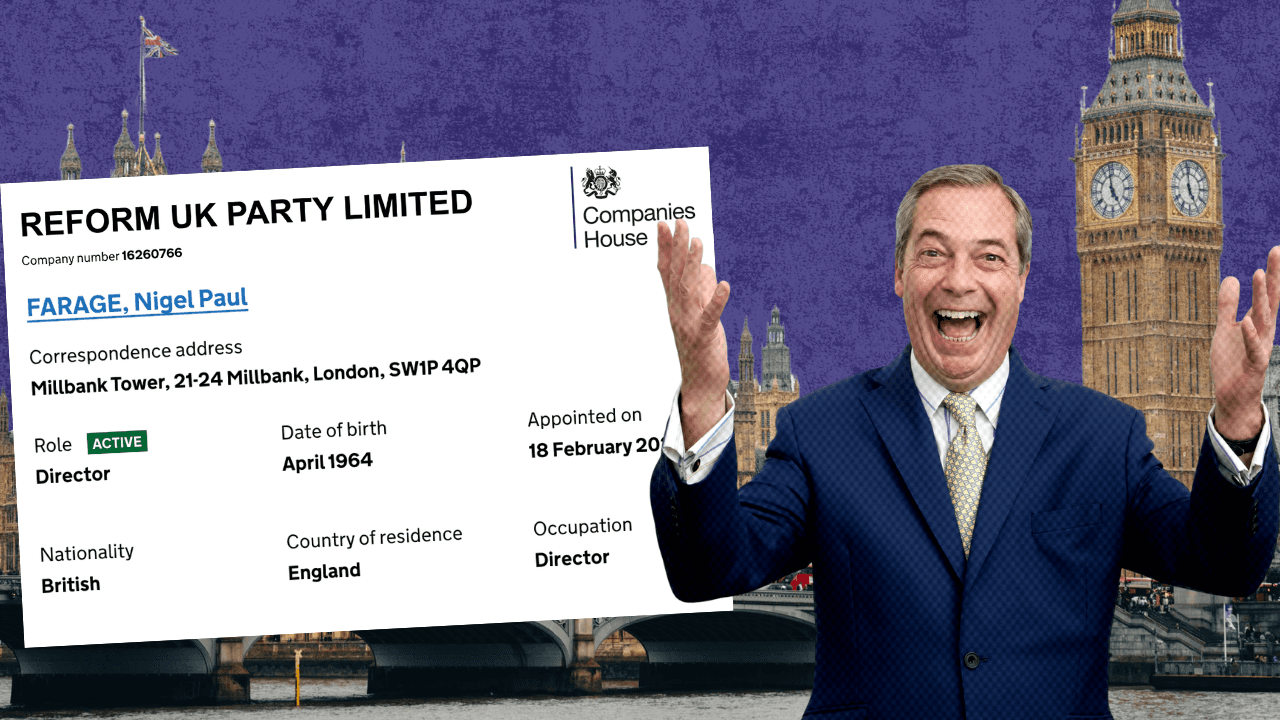
Reform UK Isn’t a Political Party. It’s a Business.
And That Should Worry All of Us
Most political parties in Britain are built on broadly similar foundations. Labour, the Conservatives, the Liberal Democrats, the Greens, the SNP, Plaid Cymru – these are all member-run organisations. Members elect their leaders, help shape policy, oversee the rulebook, and ultimately hold power.
Reform UK is something very different.
Nigel Farage’s latest venture isn’t structured like a political party at all. It’s structured like a private company. And that single decision quietly rewrites how power, money and accountability work inside a political movement.
This isn’t about policy. It’s about the health of British democracy – and the risks created when a party chooses a corporate shell over a democratic structure.
A Political Movement Built on Company Law
While most parties operate as unincorporated associations, Reform UK is built on two linked companies: a legacy entity that was once privately owned through shares, and a new company now positioned above it.
On paper, the structure lists no “persons with significant control” – a technical designation that makes it harder for the public to see who actually runs the organisation.
In practice, power is concentrated in a small group of directors operating behind closed doors.
Companies operate on different logic to political parties. Directors hold authority, not members. Constitutions can be rewritten in private. Assets – including cash – belong to the company, not supporters. Transparency requirements are weaker and easier to route around.
Farage hasn’t simply founded another party. He’s built something Britain has never seen at scale before: a political vehicle run like a private business.
And that matters.
Three Risks That Should Alarm Anyone Who Cares About Democracy
Reform UK’s corporate structure brings with it a set of dangers no modern political party has ever normalised.
Here are the three most serious.
1. Money in the Shadows
Reform UK does report donations to the Electoral Commission. But everything around that process becomes harder to track:
Money can move between its two companies before touching regulated accounts.
Revenue from merchandise, events or media activity can sit outside political rules altogether.
Company donations can obscure true beneficial ownership.
Loans and in-kind services face far lighter scrutiny.
None of this is illegal. But it exploits the fact that the law was written for political parties – not corporate groups acting like political parties.
Even the Electoral Commission admits the rules have not kept pace.
Reform UK isn’t breaking the law. It’s revealing where the law is weakest.
2. Power Without Accountability
Inside Reform UK, members have virtually no say.
They cannot meaningfully challenge or remove the leader.
They cannot block constitutional changes.
They cannot demand transparency or internal checks.
A handful of directors can set policy, select candidates, shape the rulebook and control governance with no obligation to consult supporters.
If we care about how political power is exercised, this matters. The internal structure of a party is often a preview of how it governs.
Reform UK’s design signals concentrated power, minimal guardrails and a worrying authoritarian drift.
3. Who Actually Owns a Political Party?
In a traditional political party, members collectively own the institution. The data, the brand, the campaign infrastructure, the assets – they belong to the movement.
In a company-based party, they belong to the company.
Which means they belong to its directors.
If Reform UK were wound up, rebranded or merged, supporters would have no rights over:
voter data
brand assets
campaign infrastructure
merchandise revenue
digital tools
even the cash sitting in the bank account
Everyday donors are told they are backing a grassroots rebellion. In reality, they are funnelling money into a private corporate structure controlled by a small, wealthy inner circle.
This isn’t just a personality cult. It’s a business model.
And the public has almost no visibility into who holds real power inside it.
A New Democratic Weak Spot
Electoral law was never designed for companies posing as political parties. The rules that govern donations, spending and transparency fall apart when political work is routed through corporate entities.
The Electoral Commission already struggles to regulate traditional parties. A party-company hybrid like Reform UK pushes its limits to breaking point.
Reform UK isn’t breaking the rules – it’s ruthlessly exploiting the flaws.
And unless the rules change, others will follow.
This is not a left-right issue. Every party has its problems. But the strength of British democracy depends on political organisations that are transparent, accountable and democratic from the inside out.
Reform UK represents an experiment in dismantling those safeguards.
If we ignore it, the model will spread.
What Britain Needs to Do – Now
If we want to stop corporate political parties becoming the norm, we need urgent action:
1. Close dark-money loopholes. Introduce real “know your donor” checks and full transparency requirements for political funding.
2. Shine a light on party-linked companies. If an entity performs political functions, it should fall under political transparency rules.
3. Guarantee basic internal democracy. Clear constitutions, accountable leaders and genuine member rights for every political party.
4. Consolidated accounting for political groups. One campaign organisation means one transparent set of books.
5. Strengthen the Electoral Commission. Give the watchdog real teeth, real powers and real independence.
This isn’t about party politics. It’s about making sure our democracy cannot be quietly hollowed out from within.
Democracy or Directors? The Choice Matters
Reform UK has chosen a structure that is less democratic, less transparent and more vulnerable to outside influence than anything we’ve seen in modern British politics.
Once political parties become businesses, democracy becomes a transaction.
And none of us have a right to a refund when it goes wrong.
