
Three Millionaires Behind Farage’s “People’s Revolt”
The cost of relying on three donors
Nigel Farage wants you to think he’s leading a grassroots rebellion. A party of ordinary people finally rising up against the establishment. But when you follow the money, the truth is a lot less romantic: in many ways, Farage is the establishment.
Not three million supporters – just three millionaires
Since 2019, around 75% of all donations to Reform UK have reportedly come from just three men: Christopher Harborne, Jeremy Hosking, and Richard Tice.
Not three million ordinary contributors. Three millionaires.
It’s not unusual for wealthy people to back a party because they like its politics. But when a party is reliant on a flood of cash from a tiny number of donors, the obvious question arises: whose interests does that party end up serving?
When you look at what these men are known for, and you look at what Reform UK’s leadership has been saying and promising, the overlaps are hard to miss.
Christopher Harborne – crypto cash and the stablecoin push
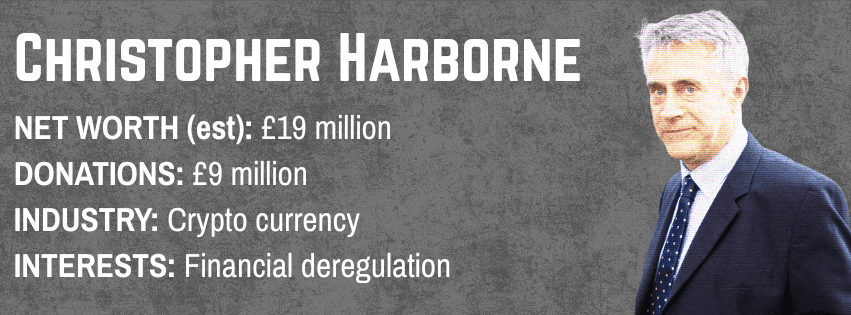
Take Christopher Harborne. He’s a major cryptocurrency investor, with reported interests linked to Tether, the “stablecoin” giant. He gave Reform UK a record £9 million – the largest political donation from a living donor in the history of British politics.
What strings came attached?
Byline Times reports that Nigel Farage has been talking up Tether, urging Britain to “embrace” it and to become a global trading centre of stablecoins, mocking calls for caution from the Bank of England as the work of “dinosaurs”.
That’s the leader of a political party, currently positioning himself as a future Prime Minister, publicly advocating for a product and a sector directly related to his biggest donor’s financial interests.
It was also revealed in November that Tether was used to facilitate the Kremlin’s war effort in Ukraine and to help Russians evade Western sanctions. So we have a party leader promoting a financial product that is not only lucrative for his donor, but also entangled in some of the most serious geopolitical conflicts of our time.
Jeremy Hosking – fossil fuels and scrapping net zero
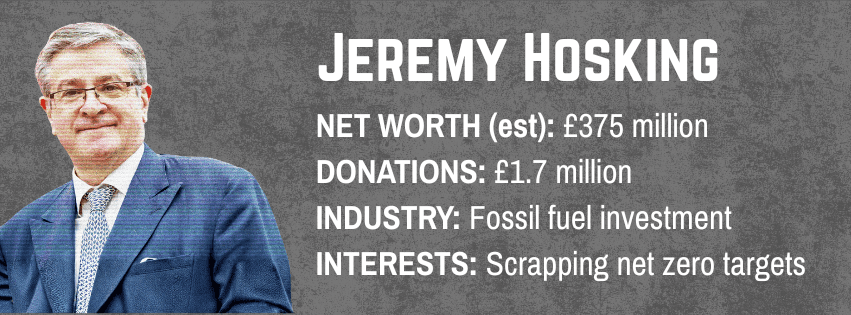
Then there’s Jeremy Hosking, who has donated £1.7 million to Reform UK. He’s a wealthy investment manager whose company, Hosking Partners, has at least $134 million invested in the fossil fuel sector. Unsurprisingly, he has strong negative opinions about net zero.
Reform UK promises to scrap net zero and related subsidies, fast-track licences for North Sea drilling and test sites, and effectively launch a full-scale reversal of Britain’s climate policies.
That would be a complete 180 from the direction Britain has been moving in. And it just so happens that donors like Hosking stand to benefit tremendously from that kind of shift.
You can’t prove a neat little quid pro quo – that Hosking donated in order to secure that policy. But it does mean that Reform UK’s climate programme is perfectly tailored to the interests of fossil fuel investors rather than voters who will live with the consequences of a destabilised climate.
Richard Tice – property, planning and who gets to build
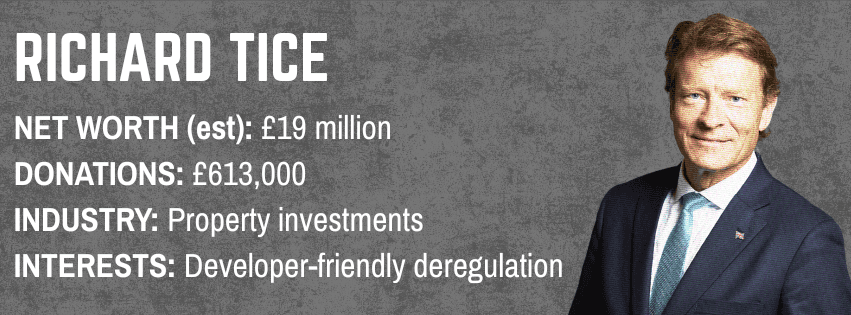
And then there’s Richard Tice, a property tycoon and Deputy Leader of Reform UK, worth a reported £40 million.
Property and planning may sound less dramatic than crypto or oil and gas, but this is where many fortunes are made in Britain. Planning policy determines who gets to build, where they get to build, and what they can extract from the public realm in the process. It is also at the heart of the cost-of-living crisis we face today, including the UK’s record-breaking squeeze on living standards.
Reform UK has mapped out a major overhaul of the planning system, including fast-track planning for brownfield sites and a “loose fit planning policy” with pre-approved guidelines.
That’s certainly developer-friendly language.
Britain does need to build far more homes, faster, and few would argue that the current system is working well. But when the party’s leadership and donor base includes a major property figure, the question “Is this in the public interest?” becomes inseparable from “Who stands to profit?”
A system built for mega-donors, not voters
Step back and the bigger picture becomes clear: three wealthy men, operating in sectors where Government has always picked winners and losers, lining up behind a party that explicitly plans to change policy in ways that make them the winners.
Reform UK is not unique in accepting large donations, but it stands as one of the starkest examples of how our broken system actually operates: a system where a handful of mega-donors can effectively underwrite a political project, and where the rest of the country is then asked to treat that project as the authentic expression of popular will.
None of this is necessarily illegal. But it exposes a very real problem – how power really works in Britain, and the urgent need to fix our democracy before it breaks entirely.
Legality is a low bar
“Is it legal?” is a low bar for judging a political finance system. A better test might be:
Is this eroding people’s basic faith in democracy?
Is our system about the needs and aspirations of voters, or just about who writes the biggest cheques?
If a party is only viable because of three very wealthy men, then those three men and their financial interests matter. And the policies that overlap with their profits deserve far more scrutiny than they currently get.
Ignore the culture wars, the red herrings and the dead cats thrown in to distract and derail debate. Britain has a growing campaign finance problem.
Until we fix it, we’ll keep getting politics shaped by the people who can afford to buy it – and sold to the rest of us as if it were a grassroots revolt.
